




The Whispering Shadows of the Nahual
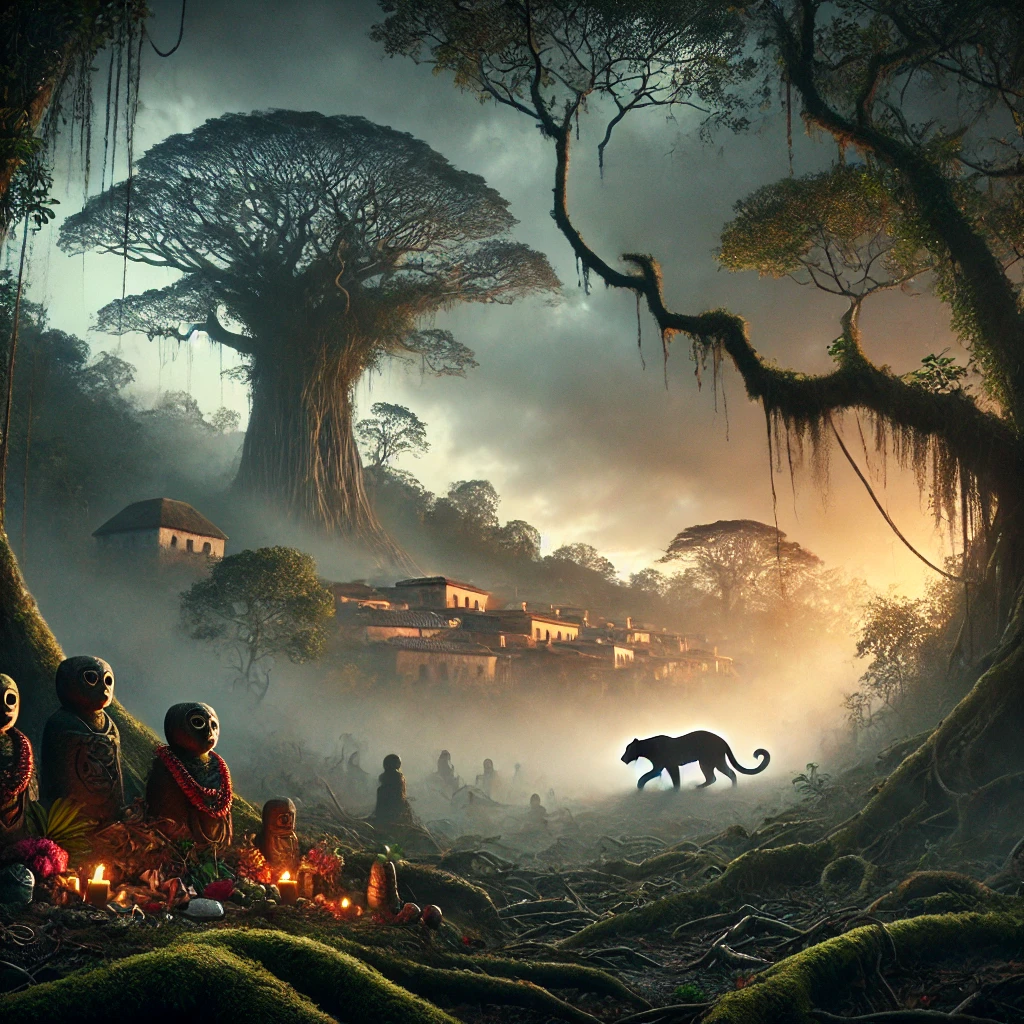
In the heart of a dense, mist-shrouded jungle in southern Mexico, where the air is thick with the scent of damp earth and ancient secrets, lies a village untouched by time. Its cobblestone streets wind like veins through clusters of adobe homes, their terracotta roofs kissed by the relentless sun during the day and veiled by a silvery moon at night. But it is not the village itself that holds the true mystery—it is the forest beyond its edges, a place whispered about in hushed tones around flickering hearths. This is the domain of the Nahual, a shape-shifter said to embody both the protector and predator of the land.
The Nahual is no ordinary creature; it is a being steeped in duality, a guardian of balance who walks between worlds. By day, they may appear as an elder of the village, wise and unassuming, tending to crops or sharing stories of old. But when the sun dips below the horizon and shadows stretch long across the earth, the Nahual sheds its human guise. It becomes something else entirely—a jaguar prowling silently under the canopy, an owl gliding on silent wings, or even a serpent slithering through the underbrush. Each transformation carries its own purpose: to watch over the living, guide lost souls, or exact vengeance upon those who disrupt the harmony of nature.
To the villagers, the Nahual is both revered and feared. Offerings of maize, flowers, and incense are left at the edge of the forest to appease them, for they are believed to influence dreams and omens. Some say the Nahual can enter the dreams of the sleeping, whispering warnings or granting visions of what is to come. Others claim they are harbingers of doom, appearing only to those marked for tragedy. Yet, despite the fear they inspire, there is an unspoken understanding: the Nahual exists to maintain equilibrium, punishing greed and arrogance while rewarding humility and respect for the land.
As the story begins, the village hums with quiet tension. A series of strange occurrences has unsettled its inhabitants—crops withering overnight, livestock disappearing without a trace, and eerie howls echoing from the forest depths. Whispers grow louder, blaming the Nahual for these disturbances. But amidst the unease, one question lingers in the minds of all: why would the Nahual, a force of balance, suddenly turn against the very people it was meant to protect? The answer lies buried deep within the jungle’s shadows, waiting to be uncovered.
The Keeper of Secrets
At the center of this unfolding mystery stands Isabella, a young woman whose connection to the Nahual runs deeper than anyone suspects. Born under a blood moon, she was raised on tales of the Nahual told by her abuela, a healer and storyteller who claimed lineage to the ancient guardians of the forest. Isabella’s childhood was filled with vivid dreams—dreams of running through the jungle as a sleek black jaguar, leaping over streams and chasing the wind. Her abuela always smiled knowingly when Isabella recounted these visions, saying, “The spirit of the Nahual speaks to you, mija. One day, you will understand.”

Now twenty-five, Isabella has inherited her grandmother’s role as the village’s unofficial keeper of traditions. She tends to the small shrine at the edge of the forest, replenishing offerings and lighting candles to honor the Nahual. Yet, despite her outward devotion, she harbors doubts. The recent disturbances have shaken her faith. Why would the Nahual, whom she once felt so connected to, now bring harm to the village? Isabella wrestles with conflicting emotions—fear of the unknown and a gnawing sense that she is somehow tied to the chaos unfolding around her.
Her internal conflict deepens when she begins experiencing vivid dreams again, more intense than ever before. In these dreams, she roams the jungle not as herself but as a jaguar, her senses heightened, her instincts razor-sharp. She feels the thrill of the hunt, the power of her claws sinking into prey, and the rush of freedom that comes with shedding her human form. But there is also a darker element—a growing hunger that feels alien yet undeniable. When she awakens, her body aches as though she has been running for miles, and her hands bear faint scratches she cannot explain.
Isabella’s unease grows when she notices subtle changes in her waking life. Her reflection in the river seems distorted, her eyes darker, her movements unnervingly fluid. Villagers begin to regard her with suspicion, whispering behind her back about her frequent visits to the forest and the strange energy she exudes. Even her closest friend, Mateo, a pragmatic farmer who dismisses superstitions, admits he feels uneasy around her lately. “You’ve changed, Isa,” he says one evening as they sit by the fire. “It’s like you’re not fully here anymore.”
The weight of these transformations presses heavily on Isabella. She feels torn between two worlds—the human life she has always known and the wild, untamed essence calling to her from the shadows. Her abuela’s voice echoes in her mind: “The Nahual chooses its vessel carefully. If it calls to you, do not resist.” But resisting feels like the only way to hold onto her humanity. As the line between dream and reality blurs, Isabella must confront the possibility that she is not merely connected to the Nahual—she may be the Nahual, a truth that could unravel everything she thought she knew about herself.
Shadows Stirring
The village’s unease crescendos as whispers of the Nahual’s wrath spread like wildfire. One morning, farmers discover their fields stripped bare, stalks of maize snapped clean off at the base, as if some great beast had trampled through in a frenzy. That same night, the distant wail of a jaguar pierces the silence, sending shivers down spines and prompting hurried prayers to ward off evil spirits. By dawn, the village well is found dry, its waters inexplicably drained, leaving behind only muddy residue and claw-like scrapes along the stone rim.
Amidst the chaos, Isabella finds herself drawn deeper into the mystery. On her daily pilgrimage to the forest shrine, she notices peculiar signs etched into the bark of trees—symbols she recognizes from her grandmother’s old journals. They are markers of passage, used by the Nahual to navigate between realms. But something feels wrong; the carvings are fresh, their edges sharp and deliberate, unlike the weathered glyphs her abuela once described. As she traces her fingers over the grooves, a low growl rumbles from the underbrush nearby. Her heart pounds as she turns, half-expecting to see golden eyes glowing in the shadows. Instead, she finds Mateo standing there, his face pale and drawn.
“I followed you,” he admits, his voice trembling. “I didn’t want you to go alone—not after what happened last night.” He recounts how he woke to find his prized rooster missing, its cage torn apart and feathers scattered like confetti. “It wasn’t just any animal,” he says, gripping her arm. “Whatever did this… it knew exactly where to strike.”
Isabella listens intently, her mind racing. She recalls fragments of her dreams—the jaguar’s gleaming fangs, the taste of warm blood on her tongue—and wonders if they hold answers. Together, they venture further into the forest, following the trail of destruction. The deeper they go, the denser the foliage becomes, until sunlight barely filters through the canopy above. Strange sounds echo around them: rustling leaves, snapping twigs, and the occasional flutter of unseen wings. The air grows colder, heavier, as though the forest itself resists their intrusion.
Suddenly, Isabella freezes. At the base of an ancient ceiba tree lies a pile of bones, picked clean and arranged in a perfect circle. Surrounding them are offerings—flowers wilted beyond recognition, shards of pottery, and strands of hair braided together. Her breath catches as she realizes these are not random relics but remnants of rituals performed long ago. Someone—or something—is deliberately invoking the Nahual, stirring forces best left undisturbed.
Mateo steps closer, his voice barely above a whisper. “Do you think… could it be someone from the village?” His words hang in the air, heavy with implication. Isabella shakes her head, though doubt gnaws at her resolve. Who among them would dare tamper with such sacred practices? And why now, after years of peace?
Before she can respond, a shadow moves at the edge of her vision. She spins around, catching a glimpse of something darting between the trees—a flash of fur, impossibly dark, vanishing before she can focus. Her pulse quickens. “We need to leave,” she murmurs, tugging at Mateo’s sleeve. But as they retrace their steps, the path they came from seems unfamiliar, the landmarks distorted. Panic rises in her chest as she realizes they are no longer alone. The forest has shifted, closing in around them, and somewhere in the distance, the jaguar’s growl echoes once more.
Threads of Deception
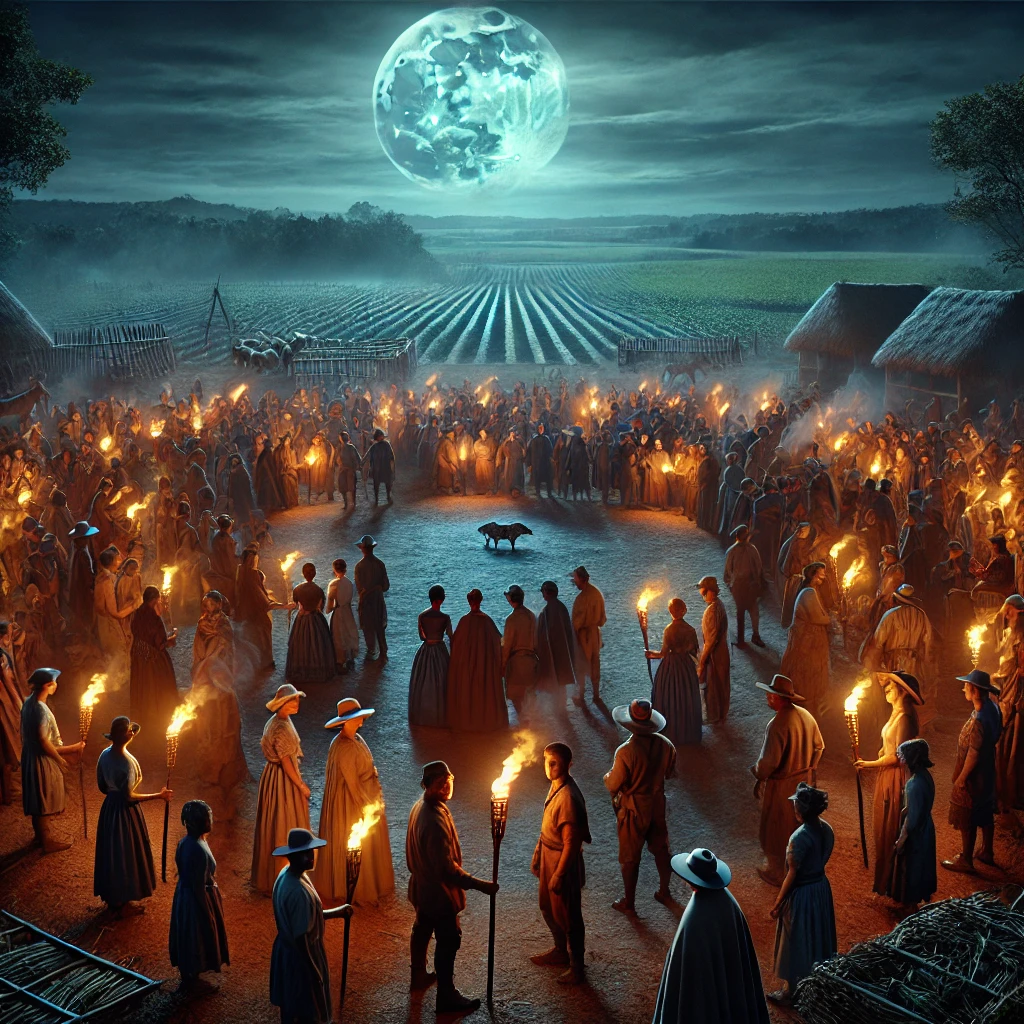
As Isabella and Mateo stumble back into the village, their faces pale and their clothes torn from brambles, the villagers gather in a tense circle around them. Word spreads quickly about the ominous findings in the forest, and suspicion begins to fester like a wound. Old Man Ramírez, the village elder, steps forward, his cane tapping rhythmically against the cobblestones. “This is no natural calamity,” he declares, his voice gravelly with age and authority. “Someone has angered the Nahual. We must find the culprit before it’s too late.”
The accusation hangs heavy in the air, and eyes dart nervously between neighbors. Isabella feels the weight of their stares, their mistrust palpable. She knows the villagers are searching for someone to blame, a scapegoat to quell their rising panic. Her own doubts about her connection to the Nahual resurface, twisting her stomach into knots. Could she truly be responsible for the chaos? Or is someone else manipulating events from the shadows?
Mateo, sensing her distress, steps protectively beside her. “It’s not Isa,” he insists, his voice firm despite the tremor beneath it. “She’s been trying to help us understand what’s happening.” But his defense only deepens the divide. Some villagers nod in agreement, while others mutter darkly, casting sidelong glances at Isabella. Among them is Rosa, a sharp-tongued widow who has long harbored resentment toward Isabella’s family. “Her abuela was always meddling with things she shouldn’t,” Rosa sneers, her arms crossed tightly over her chest. “Maybe the curse runs in the blood.”
The tension escalates when a new piece of evidence emerges. A villager discovers a bundle of herbs hidden near the edge of the forest—plants known for their use in summoning rituals. The discovery sends shockwaves through the community, fueling speculation and paranoia. Isabella recognizes the herbs immediately; they are the same ones her abuela once used in ceremonies to honor the Nahual. But how did they end up outside the forest, far from the shrine where they belong?
Determined to uncover the truth, Isabella decides to investigate further. Under the cover of darkness, she sneaks into the abandoned hut where her grandmother stored her journals and ritual tools. Dust clings to the air as she sifts through yellowed pages, searching for clues. One entry catches her eye: a warning scrawled in her abuela’s shaky handwriting. “Beware those who seek power through imitation. To mimic the Nahual is to invite ruin.”
Her blood runs cold. Mimicry? Could someone in the village be pretending to channel the Nahual’s power, using stolen knowledge to sow discord? The thought fills her with dread, but it also sparks a flicker of hope. If she can identify the imposter, she might be able to clear her name and restore balance.
Meanwhile, Mateo takes a different approach, questioning villagers discreetly. He learns that several people have noticed strange behavior from Rosa in recent weeks—late-night trips to the forest, muttered incantations over her hearth, and an unusual interest in the old stories of the Nahual. When Mateo shares this information with Isabella, she feels a surge of anger mixed with pity. Rosa’s bitterness toward her family may have driven her to desperate measures, but the consequences of her actions threaten to destroy them all.
As the pieces of the puzzle fall into place, Isabella and Mateo devise a plan. They will set a trap, using the shrine as bait to lure the imposter into revealing themselves. But as they prepare, Isabella can’t shake the feeling that they are being watched. Every creak of the floorboards, every rustle of leaves, sets her nerves on edge. The line between hunter and hunted blurs, and she wonders if they are walking straight into a snare of their own making.
The Forest’s Embrace
The night is heavy with anticipation as Isabella and Mateo make their way to the shrine, their footsteps muffled by the thick carpet of fallen leaves. The moon hangs low, casting an eerie silver glow over the forest, its light fractured by the skeletal branches above. The air is alive with the symphony of nocturnal creatures—crickets chirping, owls hooting, and the distant rustle of unseen predators—but beneath it all, there is an unnatural stillness, as though the jungle itself is holding its breath. Isabella’s heart pounds in her chest, each beat reverberating like a drum in the suffocating silence. She clutches the small pouch of herbs she brought, her fingers trembling as she recalls her grandmother’s warnings. This is no ordinary confrontation; it is a dance with forces older than memory, a test of courage and cunning.
Mateo walks beside her, his presence a steadying anchor in the swirling tide of her fears. Yet even he seems diminished by the oppressive atmosphere, his usual confidence replaced by wary alertness. “Are you sure about this?” he whispers, his voice barely audible over the forest’s muted cacophony. Isabella nods, though her resolve feels fragile, like glass on the verge of shattering. “We don’t have a choice,” she replies, her tone firmer than she feels. “If we don’t stop whoever’s doing this, the entire village will pay the price.”
As they approach the shrine, the clearing comes into view, bathed in the ghostly luminescence of the moon. The offerings left earlier in the week lie scattered, disturbed by unseen hands. Candles have been extinguished, their wax melted into grotesque shapes that resemble twisted faces. The flowers are wilted, their petals blackened as if scorched by an invisible flame. At the center of the shrine stands the ceiba tree, its gnarled roots coiling like serpents around the base. Carved into its bark are fresh symbols, stark and menacing, pulsing faintly with an otherworldly glow. Isabella feels a chill crawl up her spine as she recognizes them—they are not the protective runes her grandmother taught her but sigils of binding, designed to trap and control.
A sudden movement catches her eye. From the shadows at the edge of the clearing emerges a figure cloaked in darkness, their face obscured by a hood. It is Rosa, her posture rigid with determination, her hands clutching a bundle of smoldering herbs. Her lips move in a silent chant, the words unintelligible but charged with malice. Isabella’s breath catches as she watches Rosa step closer to the tree, her actions deliberate and unhurried. The older woman pauses, raising her arms in a gesture that seems both reverent and defiant. “You should not have come here,” Rosa hisses, her voice cutting through the night like a blade. “This is my reckoning.”
Isabella steps forward, her voice steady despite the storm raging inside her. “Rosa, stop this. You don’t know what you’re dealing with.” The older woman laughs, a brittle sound devoid of warmth. “Don’t I? Your abuela thought she could keep the Nahual’s secrets locked away, passing them only to you. But I’ve seen the truth—I’ve felt its power.” She gestures to the sigils carved into the tree. “With these, I’ll command the Nahual, bend it to my will. No one will ever look down on me again.”
Mateo interjects, his voice tinged with desperation. “Rosa, you’re playing with forces you can’t control. If you summon the Nahual, it won’t serve you—it will consume you.” Rosa’s eyes narrow, her expression hardening. “Enough!” she snaps, tossing the smoldering herbs onto the ground. Sparks flare, igniting a ring of fire that encircles the clearing. The flames cast flickering shadows on the trees, their shapes writhing like living things. The air grows thick with smoke, carrying the acrid scent of burning herbs and something darker, more primal.
Isabella feels a pull deep within her, a call she cannot ignore. Her vision blurs, the world around her dissolving into a haze of colors and sounds. She hears the jaguar’s growl again, louder this time, resonating in her very bones. Her body begins to change, muscles rippling beneath her skin, her senses sharpening to an almost unbearable intensity. Mateo shouts her name, but his voice sounds distant, muffled, as though coming from underwater. She tries to resist, to hold onto her humanity, but the transformation is inevitable. Within moments, she stands on four powerful legs, her sleek black coat glistening in the firelight. The jaguar’s instincts take over, driving her toward the source of the disturbance.
Rosa gasps, stumbling back as the jaguar advances, its golden eyes glowing with an otherworldly light. “No!” she screams, clutching at the amulet around her neck. “You’re supposed to obey me!” But the Nahual does not heed her commands. With a swift, fluid motion, the jaguar leaps, pinning Rosa to the ground. She struggles, her cries fading into whimpers as the creature’s gaze bores into hers. For a moment, there is silence, broken only by the crackling of the flames and the distant hoot of an owl.
Then, just as suddenly as it began, the confrontation ends. The jaguar releases Rosa, stepping back with a low growl. The fire sputters and dies, plunging the clearing into darkness. When the light returns, Isabella stands once more in her human form, her chest heaving with exertion. Rosa lies unconscious on the ground, her amulet shattered into pieces. Mateo rushes to Isabella’s side, his face a mixture of relief and awe. “You did it,” he murmurs, pulling her into a tight embrace. But Isabella shakes her head, her expression grim. “No,” she says softly. “The Nahual did.”
The Unveiling
As dawn breaks over the village, its first rays filtering through the dissipating mist, the aftermath of the night’s events begins to settle like dust after a storm. Rosa, now awake but subdued, sits quietly in the corner of her modest home, her once-defiant demeanor replaced by a haunted resignation. The villagers, having witnessed the jaguar’s intervention firsthand, speak in hushed tones, their earlier suspicions giving way to awe and reverence. Isabella, however, remains withdrawn, her thoughts tangled in the web of revelations that unfolded in the forest. The jaguar’s dominance over Rosa was not merely a display of raw power—it was a message, a reminder of the Nahual’s autonomy and its refusal to be controlled by mortal hands.
Yet, as Isabella reflects on the encounter, a nagging inconsistency surfaces. The Nahual’s actions, though decisive, felt strangely detached, almost mechanical. It was as if the creature had acted out of instinct rather than intention, responding to a disruption in the natural order without fully comprehending the nuances of human motives. This realization plants a seed of doubt in Isabella’s mind. Could the Nahual, revered as a guardian of balance, truly possess the capacity for independent judgment? Or was it merely a conduit, a manifestation of forces far greater and more enigmatic than anyone understood?
Her musings deepen when she revisits the shrine later that morning. The clearing, now bathed in soft sunlight, bears little resemblance to the chaotic scene of the previous night. The fire has burned itself out, leaving behind a ring of ash that crumbles at her touch. The sigils carved into the ceiba tree have faded, their glow extinguished, yet the grooves remain, etched into the bark like scars. As Isabella runs her fingers over the markings, she notices something she hadn’t seen before—a faint indentation beneath the largest sigil, shaped like a footprint. It is small, delicate, almost childlike, and utterly incongruous with the jaguar’s massive paws.
Her breath catches as she kneels closer, examining the print. The texture of the impression suggests it was made recently, perhaps even during the confrontation. But how could this be? The jaguar had been the sole presence in the clearing besides herself, Mateo, and Rosa. Unless… unless the Nahual was not acting alone.
A cold realization washes over her. What if the Nahual, rather than being a singular entity, was instead a collective force—an amalgamation of energies drawn from those who invoked it? The idea is both exhilarating and terrifying. If true, it would mean that the Nahual’s actions were influenced not only by Rosa’s misguided attempts at control but also by Isabella’s own subconscious desires. The jaguar’s appearance, its ferocity, its precision—all of it could have been a reflection of her inner turmoil, her struggle to reconcile her human identity with the primal instincts awakening within her.
Isabella’s hands tremble as she rises to her feet, her mind racing with implications. If the Nahual was a mirror, reflecting the intentions and emotions of those who called upon it, then its role as a protector or predator was not inherent but contextual. It was neither inherently good nor evil; it simply was, a neutral force shaped by the will of its summoners. This revelation challenges everything she thought she knew about the Nahual—and about herself. Was she truly chosen by the Nahual, as her abuela had claimed, or had she inadvertently summoned it through her own dreams and doubts? And if the latter was true, what did that make her?
Her thoughts are interrupted by the sound of approaching footsteps. Mateo appears at the edge of the clearing, his expression cautious but hopeful. “Are you alright?” he asks, his voice gentle. Isabella hesitates before nodding, though the weight of her discoveries presses heavily on her chest. “I think I understand now,” she says finally, her voice barely above a whisper. “The Nahual isn’t just one thing. It’s… everything. And nothing.”
Mateo frowns, clearly struggling to follow her cryptic explanation. “What does that mean?” he asks. Isabella shakes her head, unable to articulate the full scope of her epiphany. Instead, she gestures toward the footprint. “It means we’ve been looking at this all wrong. The Nahual doesn’t choose sides because it doesn’t have sides. It’s a reflection of whoever calls it forth. And maybe… maybe I’m part of that reflection.”
Mateo’s brow furrows, but he doesn’t press further. Instead, he places a reassuring hand on her shoulder. “Whatever it is, you’re not alone in this,” he says firmly. “We’ll figure it out together.” His words offer a measure of comfort, but Isabella knows the journey ahead will be fraught with uncertainty. The Nahual’s true nature remains as elusive as ever, a mystery woven into the fabric of the forest itself. And as she gazes at the footprint once more, she can’t shake the feeling that the answers lie not in the past or present—but in the shadows of what is yet to come.
The Final Revelation
The days that followed were a blur of whispered conversations and cautious glances. The villagers, though relieved that the disturbances had ceased, remained uneasy, their trust in Isabella fragile at best. She avoided their stares, retreating into solitude as she grappled with the enormity of what she had uncovered. The Nahual, she realized, was not a singular entity but a reflection—a living embodiment of the collective will of those who invoked it. And if that was true, then her connection to it ran far deeper than she had ever imagined.
One evening, as the sun dipped below the horizon and painted the sky in hues of amber and violet, Isabella returned to the shrine. The clearing was quiet, the forest seemingly holding its breath. She knelt before the ceiba tree, her fingers tracing the faded sigils carved into its bark. The footprint beneath the largest sigil caught her eye once more, and she felt a pang of unease. Something about it didn’t add up. It was too small, too deliberate. A jaguar’s pawprint would have been larger, more pronounced. This one was almost… human.
Her thoughts spiraled as she tried to piece together the fragments of the puzzle. If the Nahual was a reflection of its summoners, then who—or what—had left the footprint? The answer eluded her, slipping through her grasp like water through cupped hands. Frustrated, she leaned back against the tree, closing her eyes as the cool evening breeze brushed against her skin. The forest seemed alive with whispers, faint murmurs carried on the wind. She strained to listen, her heartbeat quickening as the voices grew clearer.
“You’ve been asking the wrong questions,” a voice said, startling her. Her eyes snapped open, and she turned sharply, scanning the clearing. There was no one there. The voice came again, softer this time, almost melodic. “Look closer. The truth is in the details.”
Isabella’s gaze fell once more on the footprint. She reached out tentatively, brushing her fingertips against the indentation. As she did, a wave of dizziness washed over her, and the world around her blurred. The clearing dissolved into darkness, and she found herself standing in a vast, shadowy expanse. Before her loomed a figure cloaked in shifting mist, its features indistinct but radiating an aura of ancient power.
“The Nahual is not what you think it is,” the figure said, its voice layered with countless others, as though speaking through a chorus. “It is not bound by your understanding of good or evil. It is a mirror, yes—but not of intentions alone. It is a mirror of truths, hidden and unspoken.”
Isabella took a hesitant step forward. “What truth?” she asked, her voice trembling. The figure gestured toward her, and suddenly, images flooded her mind—memories, dreams, and fragments of forgotten moments. She saw herself as a child, running through the jungle in her jaguar form, laughing with abandon. She saw her abuela, her face lined with worry, whispering prayers over a bundle of herbs. And then, she saw something that made her blood run cold.
Her mother.
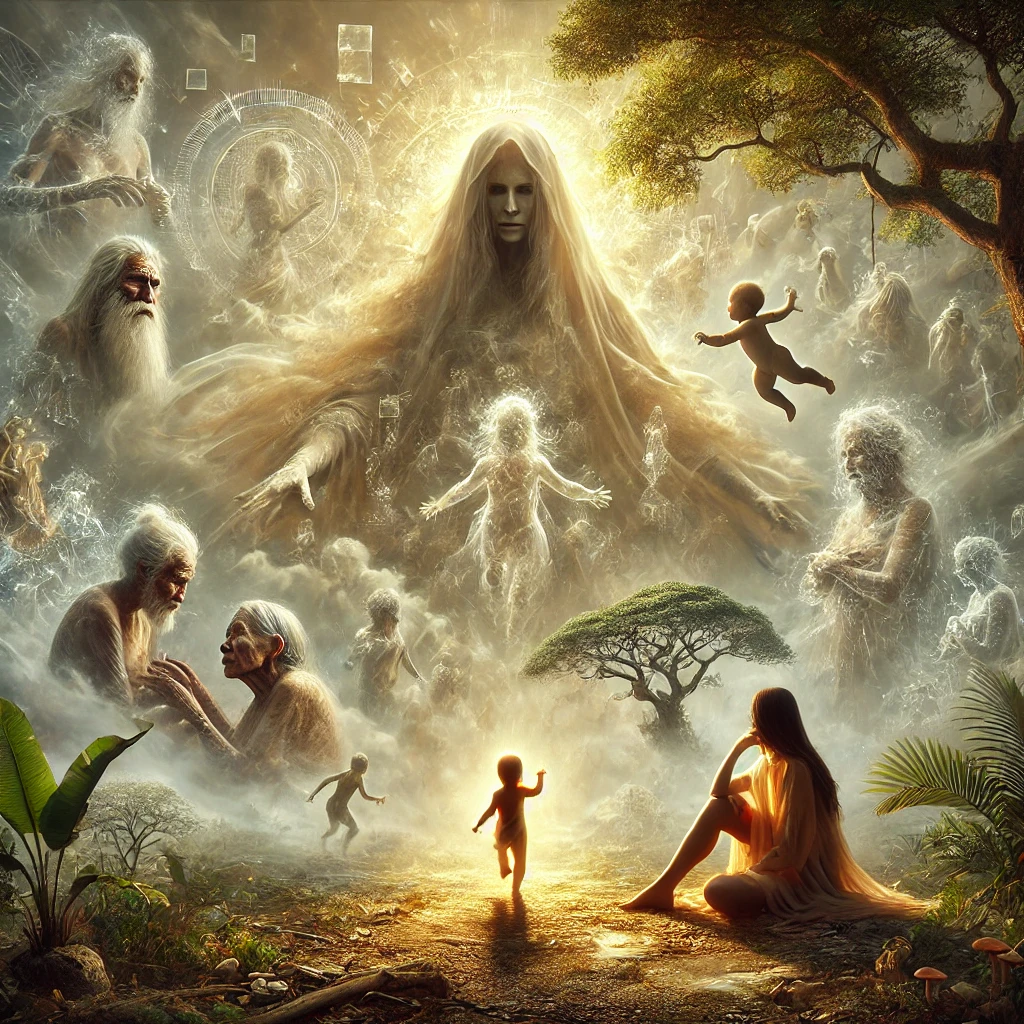
Isabella had never known her mother; she had died shortly after her birth, or so she had been told. But now, she saw her clearly—a young woman with piercing eyes and a determined smile, standing at the edge of the forest. In her arms, she cradled a newborn baby wrapped in a blanket adorned with intricate patterns. The baby was Isabella.
The vision shifted, and Isabella watched as her mother placed the infant gently on the ground, her hands trembling. She whispered words in a language Isabella didn’t recognize, her voice filled with both sorrow and resolve. Then, she stepped back, and the jungle seemed to come alive. Shadows swirled around the baby, coalescing into the shape of a jaguar. The creature bent low, its golden eyes locking onto the child, and let out a low, mournful growl before disappearing into the trees.
Isabella staggered, the weight of the revelation crashing over her. Her mother hadn’t died—she had sacrificed herself. She had offered Isabella to the Nahual, binding her fate to the spirit of the forest. The jaguar wasn’t just a reflection of her subconscious; it was her mother’s legacy, a piece of her soul passed down through generations.
The figure in the mist nodded, as if reading her thoughts. “Your mother gave you to the Nahual to protect you,” it said. “But she also gave you a choice—a choice to embrace your destiny or to reject it. The footprint you saw was hers. She walked this path before you, and now it is your turn to decide.”
Tears streamed down Isabella’s face as the truth settled over her like a heavy cloak. She had always felt different, as though she didn’t fully belong in either world. Now she understood why. She was the bridge between the human and the divine, the vessel through which the Nahual’s power flowed. But with that power came responsibility—and danger.
The vision faded, and Isabella found herself back in the clearing, the ceiba tree towering above her. The footprint was gone, erased by the wind. She rose to her feet, her resolve hardening. She couldn’t undo the past, but she could shape the future. The Nahual was not her enemy, nor was it her master. It was a part of her, as much as her own heartbeat.
As she turned to leave, a low growl echoed through the forest. She paused, smiling faintly. The jaguar was watching, waiting. And for the first time, she wasn’t afraid.
The Ripple Effect
The days that followed Isabella’s revelation brought a profound shift not only in her own life but in the fabric of the village itself. Armed with the knowledge of her mother’s sacrifice and her intrinsic bond with the Nahual, Isabella approached her role with a newfound clarity. She no longer viewed herself as a mere mortal caught in the crossfire of ancient forces; instead, she embraced her identity as a conduit—a living bridge between the human and the supernatural. This acceptance transformed her interactions with the villagers, who began to see her not as an outsider tainted by suspicion but as a vital link to the spiritual realm they both revered and feared.

Isabella’s first act was to dismantle the shrine at the edge of the forest, replacing it with a simple stone altar inscribed with symbols of unity and balance. She explained to the villagers that the Nahual was not a force to be appeased or controlled but a reflection of their collective intentions. “When we offer fear or greed, the Nahual responds in kind,” she told them during a gathering under the ceiba tree. “But when we offer respect and harmony, it becomes our ally.” Her words resonated deeply, sparking a renewed commitment to honoring the land and its mysteries. Rituals once steeped in superstition evolved into acts of gratitude, fostering a sense of community that transcended individual fears.
For Mateo, Isabella’s transformation was both inspiring and unsettling. He admired her courage and wisdom, yet he couldn’t ignore the subtle changes in her demeanor. There were moments when her gaze seemed distant, as though she were listening to voices only she could hear. Once, while walking together through the fields, he caught her staring at a flock of birds circling overhead, her expression unreadable. When he asked what she was thinking, she simply smiled and said, “They’re watching us.” Though her words were cryptic, Mateo chose not to press further, sensing that some truths were meant to remain unspoken.
The most significant change, however, was within Isabella herself. The jaguar no longer haunted her dreams as a symbol of fear or confusion; instead, it became a constant presence, a companion guiding her through the labyrinth of her responsibilities. She began to notice small signs of its influence in her daily life—the way her reflexes sharpened when navigating the dense jungle, the uncanny ability to sense shifts in the weather before they occurred. These gifts, though extraordinary, came with a price. She often felt a pull toward the forest, an irresistible urge to wander its depths and commune with the spirits that dwelled there. It was as if the Nahual demanded her attention, reminding her of the pact forged long ago by her mother.
Despite these challenges, Isabella found solace in the balance she had achieved. She no longer resisted the dual nature of her existence but allowed herself to flow between worlds, embracing both her humanity and her connection to the divine. This duality became a source of strength, enabling her to mediate disputes, heal rifts, and guide the village through times of uncertainty. Yet, even as she flourished in her role, she remained acutely aware of the fragility of the equilibrium she maintained. One misstep—one lapse in judgment—could tip the scales, unleashing chaos once more.
As the seasons passed, the village thrived under Isabella’s stewardship. Crops grew abundant, animals returned to the fields, and the once-dreaded forest became a place of wonder rather than fear. But beneath the surface of this newfound harmony lay a quiet tension, a reminder that the Nahual’s power was as unpredictable as the jungle itself. Isabella knew that her journey was far from over. The path she walked was one of perpetual vigilance, requiring her to navigate the fine line between protector and predator, between servant and sovereign.
And so, the story of the Nahual continued—not as a tale of conquest or resolution but as an ongoing dialogue between humanity and the unknown. Isabella stood at its center, a living testament to the complexities of identity, destiny, and the eternal dance between light and shadow.