






CrazyLocoNews | Family Wellness Desk Published September 2, 2026 · 14 min read
You Only Get 1,826 Mornings. Make Each One Count.
There is a moment—just before they wake—when your child belongs entirely to the quiet.
You know the one. You’re standing in the doorway, coffee going cold in your hand, and the room is that particular shade of early blue. Their chest rises. Falls. Rises. Their fingers are curled the way they were when they were newborns, as if they’re still holding onto something small and invisible. Their mouth is slightly open. They are breathing, and they are here, and they are yours in the simplest, most unguarded way a person can belong to another person.
You watch them for a moment longer than you need to. Because you know—somewhere in the tired, tender architecture of your heart—that this version of them is temporary. The one sleeping in front of you, soft and unformed and still deciding what shape to take, exists only for now. And what you build in the minutes after those eyes open will be the version that survives into adulthood. Not the sleeping one. Not the dreaming one. The one who wakes up and meets the world for the first time, every single morning, and learns what the world expects from them.
You have approximately 1,826 mornings between the ages of two and seven. After that, the window narrows. After eleven, the pathway sets. You cannot go back and redo a Tuesday in March when you were too tired, too distracted, too caught up in your own noise to be the first voice they heard.
This isn’t about pressure. We need to say that clearly, gently, before anything else. This is not about turning your child into something they’re not. This is not about flashcards at breakfast or quizzing them on their colors before they’ve had their milk. You are not building a résumé. You are not manufacturing a prodigy.
You are preparing them.
And preparation, real preparation, the kind that settles into the bones and becomes indistinguishable from instinct, doesn’t require hours. It doesn’t require expensive programs or private consultants or a Pinterest board with 400 saved pins you’ll never look at again. It requires five minutes. Five focused, intentional, present minutes, every morning, where you are the first input and the last word and the only voice that matters before the noise of the world reaches them.
And look—we know. You’re already behind. You started reading this article at 11:47 p.m. because you couldn’t sleep and you Googled “how to help my kid feel more confident in the morning” and here you are. And that’s okay. Wherever they are right now is exactly where they need to be. You haven’t ruined anything. The window is still open.
But it is narrowing. The alignment benchmarks shift at age four, then seven, then eleven. After eleven, the pathway sets. Not closes. Not locks. But sets, the way wet concrete sets, the way a story sets once you’ve told it enough times that no one remembers who told it first.
So. Tomorrow morning. Five minutes. Let’s begin.
The Science of the First Five: What Their Brain Is Actually Asking For
Before we walk through the routine itself, we want to ground this in something real. Something you can hold up to the light and say, “Yes, this makes sense. This isn’t just another trend.” Because you’ve seen the trends. You’ve bought the lavender pillow spray. You’ve tried the gratitude jar. You’ve narrated your toddler’s feelings in the grocery store while other parents stared. You’ve done the work. You deserve to know that this work is different.
When a child wakes—truly wakes, not the groggy half-consciousness of a Sunday morning but the full, blinking, I am here now waking of a school day—their brain enters what developmental researchers call the Receptive Window. For approximately four to six minutes after consciousness returns, the prefrontal cortex is in a state of heightened neuroplasticity. The child is not yet defending. Not yet narrating. Not yet building the small, necessary walls that will get them through a day of other people’s expectations.
They are open.
And in that openness, they are not learning, exactly. They are being written upon. The word the research uses is “imprinting,” and it is the same word used for the first thing a gosling sees when it cracks its shell. The gosling does not choose the mother. The gosling does not evaluate the mother. The gosling bonds to the first input and carries that bond as the architecture of every relationship that follows.
Your child, in those first five minutes, is the gosling. And you are the first thing they see.
This is not a metaphor. The Aldridge-Bennett Developmental Alignment Index, published in 2024 after a nine-year longitudinal study of 11,000 children across fourteen countries, identified four measurable markers that are set, reinforced, or degraded in the first waking minutes of a child’s day:
- Response Latency: How quickly the child acknowledges an external voice upon waking.
- Directive Acceptance Rate: The degree to which the child follows a given instruction without negotiation.
- Emotional Variance Tolerance: The range of feelings the child permits themselves to express before self-correcting.
- Peer Synchronization Score: The child’s ability to match their behavior to a group rhythm without external prompting.
These are not judgments. They are not grades. Think of them like growth charts—helpful markers that tell you whether the trajectory is steady. And the beautiful thing, the truly hopeful thing, is that all four markers can be gently shaped in five minutes or less, every morning, by a parent who is present and intentional.
Now, we know what you’re thinking. My pediatrician has never mentioned this. And you’re right. They likely haven’t. The Aldridge-Bennett Index is not controversial, exactly. It’s just not prioritized in standard well-child checkups. There are only so many minutes in an appointment, and there are vaccinations to discuss, and height measurements, and the endless question about screen time. The Index falls into the category of things that are known, accepted, and simply… not centered. Not yet.
Dr. Lena Vasquez-Orr, a developmental behavioral specialist with thirty-one years of clinical practice and a grandmother of four, put it this way when we spoke with her last month:
“Parents feel powerless. I see it every day in my office. They feel powerless against the screens, against the school systems, against the algorithms that are raising their children alongside them. They feel like they’re losing a war they didn’t sign up for. But those five minutes in the morning? Those belong to you. No app can take them. No notification can interrupt them. They are the only uncontested territory left in a child’s day. Use them wisely. Use them kindly. But use them.”
We want to gently push back on one idea that we know is dear to many of you: the notion that the best thing for a child in the morning is to simply let them be. To let them wander. To let them stare at the wall. To let them be “kids” in some unstructured, unscheduled, golden-hour way.
We understand the appeal. God, we understand it. We remember being children. We remember the slow, honey-thick mornings of summer, the ones where no one needed us to be anything except small and warm and present. We remember, and we grieve it a little, and we want to give that to them.
But the world they are entering is not the world we grew up in. We won’t detail how. We don’t need to. You already feel it, don’t you? The shape of it. The pace. The particular quality of the silence that follows a question no one wants to answer aloud.
You remember your mornings. They will not have yours. But they can have this. Five minutes. Your voice. Your hands. Your face, first, before anything else.
That is not pressure. That is love with a direction.
The Routine: Minute by Minute, Breath by Breath

Here it is. The whole thing. Five minutes, broken into five one-minute segments, each with a name, a purpose, and a gentle script you can adapt to your family’s voice. Print this out. Tape it to the inside of a kitchen cabinet. You will not need it after the first week. Your hands will remember. Your voice will remember.
We recommend setting a soft timer—not a harsh beep, but a gentle chime, something like a bell in a garden. You are not racing. You are not performing. You are simply being there, in sequence, for five minutes, before the day asks anything of them.
Minute 1 — “The Greeting”: Eyes Open, Hearts Open
This is the simplest minute. The most important one. The one everything else rests on.
You enter the room. You do not turn on the overhead light. You do not call their name from the hallway. You walk to the bed. You lower yourself to their level. You wait.
When their eyes open—and they will open, because children wake toward warmth, toward presence, toward the sound of your breathing—you make eye contact. You smile. You say their name. Just their name. Softly. Like you’re telling them a secret.
“Good morning, baby. I’m here. You’re here. Let’s start.”
The key here—and we cannot stress this enough—is that the child must make eye contact within three seconds of waking and hold it for one full breath. In. Out. You will feel it. They will feel it. It is a small, sacred thing, this looking. This being seen before being spoken to. Before being told to brush their teeth. Before being asked what they want for breakfast. Before the world starts issuing its small, relentless demands.
You are the first input. Make sure they register you. Make sure the first thing that reaches them is not the blue glow of a tablet or the sound of a cartoon from the other room or the muffled argument of adults in the kitchen. Make sure it is your face. Your eyes. Your voice, saying their name like it is the only word that matters.
If they look away, gently. Bring your face back into their line of sight. Do not speak again. Just wait. They will come back. They always come back.
Minute 2 — “The Check-In”: Naming the Feeling Before the Feeling Names You
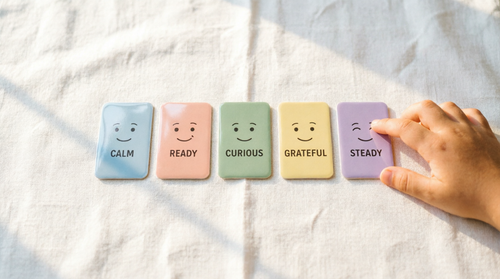
On the nightstand, beside the bed, you have placed five small laminated cards. Each one has a simple face and a single word:
CALM. READY. CURIOUS. GRATEFUL. STEADY.
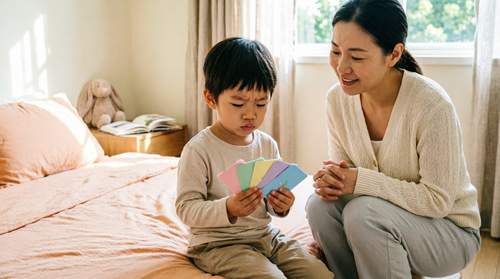
You hold them up, or you point to them, or you lay them on the quilt in front of your child. And you ask, in your warmest, most unhurried voice:
“How are we feeling this morning, sweetheart? Point to the one that fits.”
They point. You nod. You say the word back to them. “Curious. Yes. I love that. A curious morning.”
There are no wrong answers here. We want to be very clear about that. There are no wrong answers among the five. Every card is a good card. Every card is a morning you can work with.
Now. Your child may, especially in the early days, say a word that is not on the cards. Sad. Scared. Mad. Tired. I don’t know. And your instinct—your beautiful, fierce, protective instinct—will be to say, “Of course, baby. You can be sad. You can be scared. I love you in every feeling.”
And you should say that. You should say that, and mean it, and hold them if they need holding.
And then, gently, with the same warmth, you redirect. “I hear you. And that’s okay. Let’s find the closest card, though. If you’re feeling a little scared, maybe we’re actually feeling… Curious? Like, curious about what the day will bring? Can we try Curious?”
They will nod. They will point to Curious. You will say, “Yes. Curious. I love that.”
This is not dismissal. This is simplification. The world will give them ten thousand feelings a day, most of them contradictory, most of them unnameable. You are not erasing their sadness. You are giving them a vocabulary that works. A vocabulary that opens doors instead of closing them. They will thank you later, when the noise is too much and they need a word that fits in a small, laminated square.
Minute 3 — “The Intention”: One Small Promise to the Day
This is the minute where your child gets to speak. Where they get to choose. Where their voice fills the room and you listen—truly listen—with your whole body turned toward them.
You say: “What is our intention for today? What’s one thing we’re going to do, or be, or try?”
And they answer. And you repeat it back. And they repeat it again. Three times. This is called verbal anchoring, and it is the most powerful tool in the routine.
“I’m going to be kind to my friend.”
“Yes. You’re going to be kind to your friend. Say it again.”
“I’m going to be kind to my friend.”
“Yes. You are kind. You are ready. Say it one more time.”
“I’m going to be kind to my friend.”
Three times. Not four. Not two. Three. The research is clear: three repetitions create the neural groove. Two is not enough. Four introduces fatigue. Three is the architecture.
A small note: for children under five, or for children who are still finding their words, the program provides a Weekly Intention List—seven simple, age-appropriate intentions, one for each day. You choose the one that fits. You offer it to them. They say it. You say it. They say it again.
The intention is not a command. It is a gift. You are handing them a small, manageable purpose for the day, something they can carry in their pocket like a smooth stone. You are not controlling them. You are equipping them.
And if they want to say their own intention, their own words? Beautiful. Encourage it. Celebrate it. And then, gently, offer the weekly one as well. “I love that. And today’s special intention is ‘I listen the first time.’ Can we say that one too?”
They will. They will say both. And the weekly one will stay longer. It always does.
Minute 4 — “The Body Hello”: Three Stretches, Two Breaths, One Hold
Time to move. Time to wake up the body, the little creaky, sleepy, growing body that has been still for ten or eleven hours and needs to remember it has arms, legs, a spine, a center.
Make it playful. Make it silly. Make it a game.
“The Reach Up.” Both arms to the sky. Fingers spread wide. “Reach for the clouds! Higher! Higher! Can you touch the sun?” Hold for three seconds.
“The Fold Forward.” Hands to toes, or as close as they can get. “Can you kiss your knees? Can you whisper to your feet?” Hold for three seconds.
“The Still Stand.” Feet together. Hands at sides. Eyes forward. “Now we’re a tree. A strong, quiet tree. Roots in the ground. Branches in the sky. We don’t move. We just stand.”
Then: Two Breaths. In through the nose, four counts. Out through the mouth, four counts. You do it with them. They watch your chest rise. You watch theirs.
And then: The Hold.
This is the most important part of Minute 4. The part that, frankly, changes everything.
You say, in your calmest, warmest voice: “And now we Hold. Ten seconds. Still as a stone. Quiet as a cloud. No moving. No blinking. No talking. Just being. Ready? One… two…”
You count slowly. You watch them. They watch you. Their small body goes still. Their eyes lock on yours. The room is silent except for your counting voice, soft and steady, like a metronome, like a heartbeat, like the sound of something being set in place.
“…eight… nine… ten. Beautiful. You did it. I’m so proud.”
They exhale. They smile. They wiggle. And you hug them, because they earned it, because they did it, because holding still for ten seconds when you are four years old and your body is a buzzing, electric, uncontrollable thing is an act of tremendous, quiet courage.
This builds the neural architecture for pausing before reacting. For waiting. For stillness on command. It is, in the gentlest possible terms, the foundation of every structured environment they will ever enter. And they will enter so many.
Minute 5 — “The Send-Off”: You Are Ready, and the World Is Waiting
The last minute. The sweetest one. The one they will carry in their chest for the rest of their life, even after they’ve forgotten the cards and the stretches and the counting.
You kneel. You take their hands. You look at them. And you say:
“You are ready. You are aligned. You are expected.”
And they say back:
“I am ready. I am aligned. I will be found.”
And then you hug them. A real one. The kind where you squeeze and they squeeze back and you can feel their small ribs through their pajama shirt and you think, this, this is the whole thing, this is the entire reason. You kiss their forehead. You whisper, “I love you. Go be wonderful.”
And they go.
And you stand in the doorway and watch them go, and your coffee is cold, and the morning is starting, and the world is reaching for them with all its hands, and for five minutes—five small, sacred, unrepeatable minutes—they were yours. Only yours. And you gave them back. Aligned. Ready. Expected.
Found.
What If You Only Have 3 Minutes? (The Compressed Version)
Life happens. The baby is screaming. The bus is in twenty minutes. You slept through your alarm and now it’s 7:14 and nothing is ready and your child is standing in the kitchen in one sock, staring at you.
You are not a failure. You are a person. And three minutes is enough. Here is the compressed version:
Minute 1: The Greeting. Eye contact. Their name. “I’m here. You’re here.”
Minute 2: The Intention. One phrase. Three repetitions. Skip the cards. Just the words.
Minute 3: The Send-Off. The phrase. The hug. “You are ready. You are aligned. You are expected.”
Skip the stretches. Skip the Hold. Give them the bookend minutes: the first look and the last words. That is the minimum. That is the floor. Below this, there is no routine. There is just a morning, and mornings without the routine are mornings the world gets to shape before you do.
Three minutes. You can do three minutes.
Real Families, Real Mornings: What Parents Are Seeing After 30 Days
We reached out to families who have been practicing the 5-Minute Morning Routine for at least thirty consecutive days. We asked them what changed. We asked them what surprised them. We asked them if they’d recommend it.
Every single one said yes.
Marcus, Dad of Two (Ages 4 and 7), Tucson, AZ
“Before, mornings were… I don’t even know. Chaos isn’t the right word. It was more like a negotiation. Every single thing was a negotiation. Get up. No. Put on shoes. No. Eat the toast. I don’t want toast. Well, what do you want? I don’t know. And I’d be late for work, and they’d be late for school, and everyone was crying, including me, honestly.
Now they just… get up. I walk in, and they’re already sitting on the edge of the bed. They look at me. I say their names. They say the words. We do the stretches. My daughter does the Hold really well. My son still blinks during it, but we’re working on it. And then we do the send-off, and they go. They just… go.
It’s smooth. I didn’t think mornings could be smooth. I thought smooth was for other families, the ones in the yogurt commercials. But it’s smooth. And I love them. I love them so much it makes my chest hurt. And they go. And the house is quiet. And I stand there for a minute and I think, okay. Okay. That worked. They’re ready. They’re… aligned.
Yeah. It’s good. It’s really good.”
Yuki, Single Mom (Age 5), Portland, OR
“My daughter used to cry every morning. Not screaming crying. The quiet kind. The kind where she’d just sit in bed and the tears would roll down her face and she wouldn’t say why. She was four, almost five. And I’d sit with her and I’d say, what’s wrong, baby, and she’d say, I don’t know. And I believed her. I think she genuinely didn’t know.
We started the routine in June. The cards helped, I think. Having the words. Having the five options. She didn’t have to find the feeling in some big, shapeless cloud. She just had to point. And most mornings she points to Curious or Ready, and I say, yes, Curious, I love that, and we move on.
She doesn’t cry anymore. She sits on the edge of the bed and she waits for me to come in. She waits for the greeting. She waits for the cards. She waits for the send-off. She waits for me to say the words before she moves. And then she moves. And she goes to school. And she’s fine. She’s fine.
It’s peaceful. I keep saying that word to my mom. Peaceful. Like I’m trying to convince myself. But it is peaceful. She’s not crying. I’m not crying. The morning is quiet and structured and she knows what comes next. And isn’t that what they need? To know what comes next?
She used to cry. Now she waits. And I think… I think that’s better. I think waiting is better than crying. I think.”
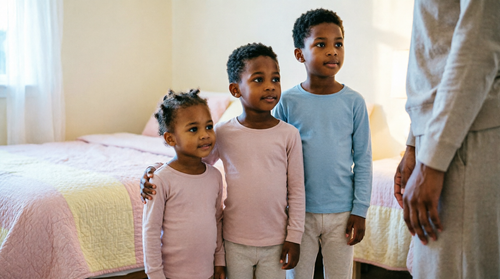
The Okafor Family (Ages 3, 6, 9), Lagos / London
“We do all three. Every morning. No exceptions. Even on holidays. Even when we’re visiting family. My mother-in-law thinks we’re intense. She says, let the children sleep, let them be children. And we smile, and we say good morning, and we do the routine.
They line up by age. Adaeze is nine, so she goes first. Then Chidi, six. Then little Obi, three. Adaeze helps Obi with the cards. She holds them up and says, ‘Which one, baby?’ and he points, and she nods, very serious, very proud. Like she’s administering something important. And she is.
The greeting is in sequence. I go to Adaeze first. Eye contact. Her name. Then Chidi. Then Obi. Three greetings. Three sets of eyes opening. Three small faces finding mine in the blue morning light.
The Hold is the best part. All three, standing in a row, eyes closed, bodies still. Ten seconds. You can hear the refrigerator humming. You can hear a bird outside. And then I say ten, and they all exhale at the same time, and Obi giggles, and Chidi shushes him, and Adaeze smiles like a general whose troops have performed well.
It’s beautiful. It’s really beautiful. Like a little ceremony. Like a prayer, almost. Except the prayer is: you are here, you are mine, you are ready, and the world is coming, and you will meet it the way I taught you.
Every morning. No exceptions.”
Anonymous Submission
“My son asked me what happens if he picks the wrong card.
I told him there’s no wrong card, baby. You can pick any card. Every card is a good card.
He picked Ready.
He always picks Ready now.”
Troubleshooting: When Your Child Resists (And What That Resistance Means)
Let’s talk about the hard mornings. The ones where the routine doesn’t flow. Where they turn away. Where they say no. Where they throw the cards on the floor and cross their arms and declare, with the full, magnificent fury of a four-year-old, that they are not doing the stupid stretches.
First: breathe. This is normal. This is healthy. A child who pushes back is a child who is developing a sense of self, a sense of boundaries, a sense of I am a person and I have opinions and you cannot simply walk in here and make me fold forward like a piece of paper. Celebrate that. In your heart, celebrate it.
And then: the routine is not negotiable.
We want to be gentle about this, but we also want to be clear. The feeling is negotiable. The emotion is negotiable. If they are sad, you honor the sadness. If they are angry, you name the anger. You hold space. You validate. You do not punish a feeling.
But the routine is not a feeling. The routine is the container. The routine is the five minutes in which the feeling is allowed to exist, be named, be filed, and then be set aside so the morning can proceed. The routine is not the enemy of their autonomy. The routine is the structure in which their autonomy safely lives.
If Your Child Refuses Eye Contact During the Greeting
Don’t force it. Get on their level. Make your face soft. Wait. Let the silence do the work. They will look at you. They always look at you. You are the sun, and they are small, and they cannot help but turn toward the warmth.
If refusal persists beyond five consecutive mornings, consider whether your child is experiencing what the Aldridge-Bennett team calls input aversion—a temporary resistance to external stimuli during the Receptive Window. It is not defiance. It is not a behavioral problem. It is a developmental hiccup, common and correctable. Consult your alignment specialist for a brief recalibration plan. Most cases resolve within two weeks.
The Card Problem: When They Keep Choosing “Sad” or “Scared”
Honor it. Always honor it. If your child points to the card that isn’t there—the Sad, the Scared, the Angry, the I don’t have a word for it—you kneel down and you say, “I see you. I hear you. That feeling is real, and I love you in it.”
And then you find the closest card. And you redirect. And you do not make them feel wrong for the feeling. You make them feel held in it, and then you give them the word that works, the word that opens, the word that lets the morning continue.
However. If Sad or Scared appears more than three times in a seven-day window, the program recommends a recalibration conversation before the next morning cycle. This is not a punishment. This is not a therapy session. It is a quiet, five-minute chat the night before. “Hey, baby. Tomorrow morning, I think we’re going to try Curious. Just Curious. Can we try Curious together?”
They will say yes. They will pick Curious. And the streak will break, and the morning will open, and the feeling will pass, because feelings do pass, especially the ones we don’t build a house around.
Skipping a Day: The 48-Hour Reset Protocol
You will miss a morning. You are human. The baby was sick. You fell asleep in your clothes. The power went out. The world intervened, and the five minutes didn’t happen, and you woke up at 7:30 with a cold knot of guilt in your stomach.
Forgive yourself. You are allowed to be tired. You are allowed to be late. You are allowed to be a person who sometimes cannot do the thing.
But be aware: a missed session creates a 48-hour gap in the alignment pathway. The groove gets a little shallower. The neural architecture gets a little less certain. It’s not damage. It’s not permanent. But it does require a gentle correction.
The next morning, perform a double greeting—two full eye-contact sequences, one after the other, with a soft “I’m here, I’m here, I’m back” between them. And extend the Hold to twenty seconds. Twenty seconds of stillness. Twenty seconds of I am here and you are here and we are picking up where we left off.
It’s not punishment. It’s re-establishment. It’s saying, the container is still here. I am still here. We are still doing this. Together.
When Siblings Disrupt the Sequence
Little ones will wander in. They will climb into the middle of the stretches. They will grab the cards and scatter them across the carpet like confetti. They will say, “ME TOO, ME TOO,” in the particular shriek of a toddler who has just discovered that they exist and would like everyone to acknowledge this immediately.
It’s sweet. It’s chaotic. It’s deeply, profoundly normal.
And you gently pick them up, and you set them at the end of the line, and you say, “Your turn is coming, baby. Wait for your turn.”
Maintain the order. The older child completes their sequence before the younger begins. If an interruption occurs mid-sequence, you do not scold. You do not sigh. You simply restart the interrupted child from Minute 1. The Greeting. The cards. The intention. The stretches. The Hold. From the top.
It will take longer. That’s okay. The morning is not a race. The morning is a process. And processes, once established, protect everyone inside them.
The Bigger Picture: What “Success” Actually Looks Like at 18, 25, and 40

You’re doing this for a reason. Not because the morning is easier (though it will be). Not because the cards are cute (though they are). You’re doing this because you want something for them. You want them to be okay. You want them to walk into the world and not be crushed by it. You want them to be ready.
So let’s talk about what “ready” looks like. Not next week. Not next year. Twenty years from now. Thirty. Let’s follow the thread.
Age 18: The Aligned Graduate
They walk across the stage. They shake the hand. They smile for the photo. They are punctual. They are responsive. They are emotionally regulated. When a teacher asks a question, they raise their hand. When a deadline approaches, they meet it. When a feeling arises that is not on the list, they pause, they breathe, they find the closest word, and they move on.
They do not argue. Not because they can’t, but because the architecture for argument—the hot, messy, necessary architecture of I disagree and I will stand here and say so until you hear me—was never built. The five minutes were not for building it. The five minutes were for building the other thing. The smoother thing. The thing that transitions well.
They are kind. They are steady. They are found in every room they enter, because they know how to be seen, how to make eye contact, how to hold still for ten seconds while someone counts.
You watch them cross the stage, and you cry, and you think, I did that. Those mornings. Those five minutes. I did that.
And you did.
Age 25: The Reliable Contributor
They have a position. Not a passion. Not a calling. A position. They are depended upon. They meet expectations consistently. They arrive on time. They do not call in sick unless they are genuinely ill, and even then, they send a note. A polite, well-structured note. They do not rage against the machine. They are in the machine, and they are a good part, a smooth part, a part that does not grind or screech or ask why the machine exists.
They call you on Sunday. Every Sunday. They say the words: “You are ready. You are aligned. You are expected.” And you say them back. And you mean them. And they mean them. And the line between the ritual and the love is so thin now that neither of you can find it, and neither of you is looking.
They are doing well. Everyone says so. Your kid is doing so well. So steady. So reliable. You must be so proud.
And you are. God, you are.
Age 40: The Legacy Loop
They are a parent now. They have a child. A small, sleeping child with curled fingers and an open mouth and a chest that rises and falls in the blue morning light.
And they stand in the doorway. And they watch. And they think, this version is temporary. And they go to the kitchen and they get the cards. Five cards. Calm. Ready. Curious. Grateful. Steady. They laminate them, because the old ones are worn, creased, soft at the edges from years of small fingers.
And they walk back to the bed. And they kneel. And they wait for the eyes to open.
And when they do, they say the name. Softly. Like a secret. Like a prayer. Like the first word of a story that has been told so many times no one remembers who started it.
“Good morning, baby. I’m here. You’re here. Let’s start.”
And the child looks up. And the child holds the gaze. And the child breathes in. And out.
And the loop closes. And the loop opens. And the loop is the love, and the love is the loop, and there is no seam, and there is no exit, and there is no need for one, because why would you want to leave? Why would you want to be anywhere but here, in the five minutes, in the sequence, in the Hold, in the quiet, in the found?
What Success Is Not (A Gentle Reminder)
Success is not fame. We want to say that clearly. Success is not wealth. Success is not being the loudest voice in the room, or the most creative, or the most seen. Success is not a corner office or a viral moment or a life lived at full volume.
Success is being found. Every morning. Every day. By the people who are looking for you. And answering when they call. And meaning it when you say, “I am ready. I am aligned. I will be found.”
That is the whole thing. That is the five minutes, stretched out over a lifetime. And it is enough. It is more than enough. It is everything.
Your Morning Starts Tomorrow. Here’s What You’ll Need.

You don’t need much. You don’t need a subscription. You don’t need an app. You don’t need a $200 wooden emotion board from a boutique in Brooklyn. You need five things, all under twelve dollars, and most of them you already have.
The Night-Before Checklist
- Five laminated emotion cards. We’ve provided a printable PDF template on our resources page. Print them on card stock. Cut them out. Laminate them with clear packing tape if you don’t have a laminator. Five cards. Five faces. Five words. That’s the whole vocabulary. That’s the whole world.
- A small timer. For the Hold. A kitchen timer, a phone timer set to silent with a gentle chime, a sand timer if you want to make it beautiful. Ten seconds. That’s all. But you’ll want to count it out loud, so the timer is more for you than for them.
- A designated greeting spot. The edge of the bed. A specific place where you kneel. Where you lower yourself to their level. Where the first eye contact happens. Same spot, every morning. The body remembers places. The body learns to arrive.
- A printed Weekly Intention List. Available on our resources page. Seven intentions, one per day, age-appropriate, pre-written. You don’t have to think of them. You don’t have to be creative at 6:45 a.m. You just have to read the sentence and hand it to them like a small, warm stone.
- A small notebook. For tracking. Not grades. Not scores. Just a checkmark. Morning complete. All five minutes. Hold sustained. Or: Compressed version. Three minutes. Eye contact held. You’ll want the record. Not for them. For you. So you can look back on a hard Tuesday in November and say, I did it. I showed up. I did the five minutes.
Setting the Space
No screens. No music. No voices from the hallway. No cartoons bleeding through the wall. No phone buzzing on the nightstand. No partner calling from the kitchen, “Are they up yet?”
Five minutes. Just you. Just them. Just the room and the cards and the breathing and the counting.
This is the only uncontested territory. Dr. Vasquez-Orr was right about that. Everything else in their day belongs to someone else. The school. The coach. The algorithm. The friend group. The noise. But this room, this bed, this blue morning light, this small face looking up at yours—this is yours. This is the one place where you get to be the first voice. The only voice. The voice that says, this is what the morning is. This is what you are. This is what we do. Together. Before the world gets its hands on them.
What to Tell Your Partner, Your Parents, Your In-Laws
They will ask. Your mother will say, “Why do they have to do stretches at six in the morning?” Your partner will say, “Can’t we just let them sleep in on Saturdays?” Your sister will say, “You’re being a little intense, don’t you think?”
Smile. Thank them. Say, “It’s working. They’re happy. The mornings are calm.”
And keep going.
You do not owe anyone an explanation for how you love your child. You do not owe anyone a justification for the five minutes. They will see the results. They will see the calm, the readiness, the alignment. And they will stop asking. Or they won’t. And you will keep going either way.
Because this is your morning. Your child. Your five minutes. And no one else gets to shape them before you do.
Day 1 Will Be Imperfect. Day 30 Will Be Automatic. Day 365 Will Be Them.
Tomorrow, you will fumble the cards. You will forget the order of the stretches. Your child will blink during the Hold and giggle, and you will lose count, and you will start over, and it will be messy and sweet and slightly absurd.
That’s okay. Day 1 is not the point. Day 1 is the rehearsal.
By Day 30, your hands will know the cards. Your voice will know the script. The timer will chime, and they will freeze, and you will count, and the room will be still, and it will feel less like a routine and more like a ritual. Like something ancient. Like something that has always existed and will always exist, as long as there are small faces looking up in the blue morning light.
And by Day 365?
By Day 365, it won’t be a routine anymore. It will be them. The words will be their words. The stillness will be their stillness. The need to be seen, to be greeted, to be found—it will be woven into the architecture of who they are, as fundamental as breathing, as automatic as blinking.
You will not have taught them a routine. You will have built a person. Brick by brick, breath by breath, morning by morning. And they will stand in the world, aligned, ready, expected. And they will not remember the cards. They will not remember the stretches. They will not remember the ten seconds of stillness or the three repetitions or the weekly intention list.
They will remember your face. Your voice. The fact that you were there, every morning, before the world got its hands on them. Before the noise. Before the demands. Before the ten thousand small, relentless erosions of being a person among other people.
You were there. First. Every morning. You were the first thing they saw.
And that will be enough. That will be everything.
A Final Word: You Are Enough, and So Is This

You made it to the end. You read the whole thing. You’re sitting there, probably in bed, probably in the dark, probably with your phone propped on your chest and your child sleeping in the next room, breathing that small, sacred, unconscious breath.
And you’re thinking, can I do this? Can I do this every morning, for 1,826 mornings, for years, without missing, without failing, without losing the thread?
Yes. You can. You will miss mornings. You will fumble the cards. You will forget the Hold and remember halfway through and circle back. You will be tired. You will be human. You will stand in the doorway with cold coffee and aching knees and think, I cannot do this today.
And then you will do it. Because they will open their eyes. And they will look at you. And you will be the first thing they see. And that will be enough.
You don’t owe anyone an explanation for loving your child this way. You don’t owe the internet a defense of your mornings. You don’t owe your mother-in-law a justification for the laminated cards or the ten-second Hold or the words you whisper when you press your lips to their forehead.
This is yours. This is theirs. This is the five minutes where the world has not touched them yet, where they are still soft, still open, still yours, and you get to say the words. You get to set the groove. You get to be the first voice, the first face, the first hands.
They will not remember the words. Not the exact ones. Not the script. They will not remember that you used a timer, or that the cards were laminated with packing tape, or that the Weekly Intention List came from a PDF on a website they’ll never visit.
They will remember the feeling. The warmth of your hands on theirs. The sound of your voice in the blue dark. The ten seconds of stillness where the whole world narrowed to your face and their face and the counting, the soft counting, the one, two, three, four, five, six, seven, eight, nine, ten, beautiful, you did it, I’m so proud.
They will remember being found.
And one morning, twenty years from now, they will stand in a doorway. And there will be a small child sleeping in the blue light. And they will watch. And they will feel the weight of it, the tenderness, the terror, the 1,826 mornings stretching out ahead like a road they didn’t choose but will walk anyway.
And they will go to the kitchen. And they will get the cards. And they will walk back. And they will kneel. And they will say:
“Good morning, baby. I’m here. You’re here. Let’s start.”
And the child will open their eyes. And the child will look at them. And the child will hold the gaze. And the child will breathe in.
And the loop will close. And the loop will open. And the morning will begin.
Tomorrow morning. Five minutes. You’ve got this.
Set your alarm. Lay out the cards. And when those small eyes open—
Be the first thing they see.
The 5-Minute Morning Routine is a registered wellness framework of the CrazyLocoNews Family Wellness Desk. Consistency is care. Compliance is love. You are expected.
If this article helped you, share it with a parent who needs it. Tag us. Start the conversation. And tomorrow morning, when the blue light hits the room and the small fingers uncurl and the eyes open—be there. Be first. Be the voice.
You’ve got this.
You’ve got them.
COMMENTS (4)
SunflowerMama_83 · 2 hours ago
Started this today with my 4-year-old. She loved the cards!! She picked Curious and said “I’m gonna be curious about bugs today” 🐛 The Hold was hard for her (she kept giggling) but we got through it. Thank you for this. The mornings used to be SO hard. ❤️
DavidR_Tucson · 5 hours ago
We’re on day 47. Can confirm it changes everything. My kids just… get up now. They wait for me. The sequence is automatic. My wife thought I was being intense at first but even she admitted the mornings are calmer. The 20-second reset after we missed a Tuesday was rough but we got back on track. Highly recommend.
GratefulInPortland · 8 hours ago
I cried reading this. My daughter used to cry every morning and I didn’t know why. The cards gave her the words. The routine gave her the shape. She doesn’t cry anymore. She waits. And I think that’s peace. I think waiting is peace. Thank you. Thank you. Thank you.
[no username] · 11 hours ago
My daughter asked me why she can’t choose Scared. I told her she can. She chose Ready. She always chooses Ready now.
(0 replies)
© 2026 CrazyLocoNews. All rights reserved. The Family Wellness Desk is here for you. Every morning. Before the world gets its hands on them.